
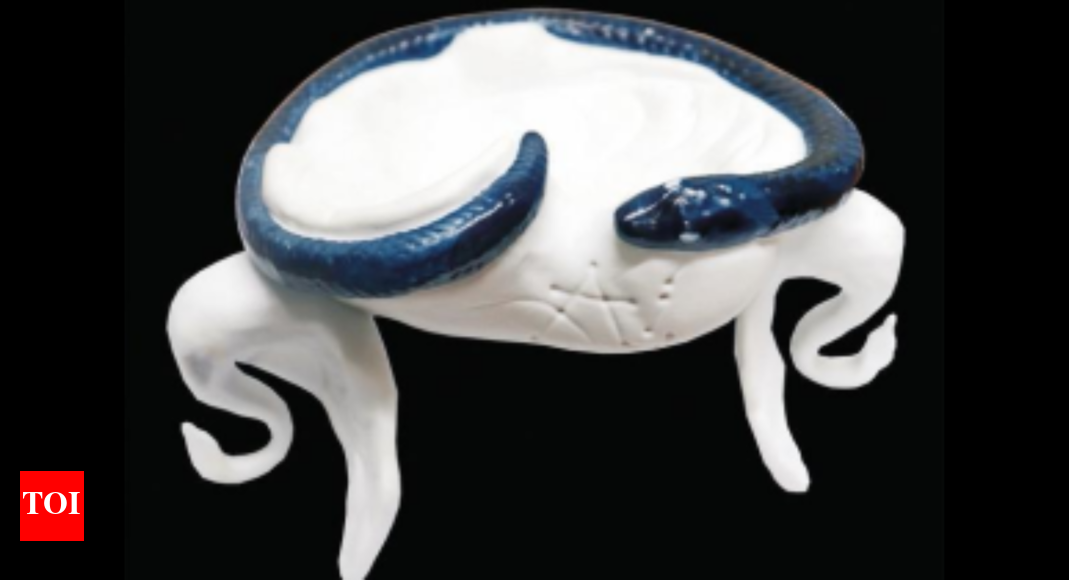
Two elephant heads that look like upturned swans hold up a 1967 ashtray whose maker carried moustaches in his cigarette case. As payment for designing this porcelain souvenir for Air India‘s first-class passengers, Spanish surrealist Salvador Dali wanted an elephant in place of money.
Today, over half a century since a two-year-old pachyderm and a mahout were flown out from Bangalore to Europe to fulfil the eccentric artist’s whim, Dali’s real elephant is dead but his porcelain elephants will soon sit next to Husain’s oil-on-canvas horses as fellow carriers of national heritage.
The seashell-shaped white ashtray-on whose rim sits a glazed blue serpent-is among 200 handpicked antiques from Air India’s iconic art collection that will be displayed for the first time in India at NGMA Mumbai from April 27 to June 2. Titled ‘Maharaja’s Treasure’, the show__which will be inaugurated in the presence of union minister of culture and tourism, G Kishan Reddy__comprises paintings and sculptures by eminent artists such as M F Husain, VS Gaitonde, G R Santosh, K H Ara, B Prabha, Pilloo Pochkhanawala and Raghav Kaneria. Phad and Pichwai paintings of Rajasthan and Thanjavur gilded and glass paintings are among the other highlights.
Curated to focus on the works that Air India used to “redefine” air travel, the show is the first of many to be hosted in the wake of an MoU in January 2023 that saw Air India handing over its ‘Maharaja Collection‘ to NGMA in Delhi. As the nodal office for the implementation of ‘Mumbai Kaustubh’-an initiative meant to revitalise cultural spaces-NGMA Mumbai was keen to host the first display of the exhibits that will be housed at the gallery for posterity after the show closes on June 2.
“Air India played a pivotal role in supporting and propagating art, artists and multiple creative endeavours at a time when the traditional patronage towards these areas was declining,” says NGMA director Nazneen Banu, referring to the national carrier’s seven-decade-long post-Independence collection.
Designed to “connect at multiple levels, the multi-storeyed show begins with an untitled warm-hued 1970 canvas by the legendary modernist V S Gaitonde. If the ground floor seems preoccupied with the works of great men spanning Padma Bhushan awardee N S Bendre to Lalit Kala Akademi awardee Manu Parekh, the next floor compensates. Here, the blue crescent moon on the head of a woman in artist Arpana Caur’s ‘Women hold up half the sky’ is not really a moon. It’s a vessel that the woman, who works among other women in a construction site, carries on her head. Mounted on two window frames are two works by Anjolie Ela Menon. ‘Nawab with pigeon’ depicts a little girl’s longing to break away from the patriarchy represented by the figure of the Nawab while ‘Lady with kite’ portrays a little girl’s “desire to experiment with the possibilities that exist outside”. The next floor becomes a higher plane with the abstract canvases of Achuthan Kudallur and Laxman Shrestha making way for SG Vasudev’s ‘Kalpavriksha’-the tree of life-flanked by the deities, Ganesha and Brahma. On the way out, heads that revert to Dali’s showstopping ashtray will be reminded of the baby elephant from the Bangalore zoo that breathed its last at the Barcelona Zoo in 2018. Spain is said to have declared a two-day national holiday to welcome the two-year-old Indian elephant that had flown with a mahout to Geneva and travelled to Dali’s house on a truck after clearing customs.
Dissuaded by his wife from crossing the Alps on its back, Dali had donated the elephant he had named Surus to the Barcelona Zoo in the 1970s. Surus died five years ago but at least one Air India artefact probably lives on in Spain’s own maharaja collection. Juan Carlos I, the former king of Spain, was among the royal recipients of Dali’s ashtray.
Today, over half a century since a two-year-old pachyderm and a mahout were flown out from Bangalore to Europe to fulfil the eccentric artist’s whim, Dali’s real elephant is dead but his porcelain elephants will soon sit next to Husain’s oil-on-canvas horses as fellow carriers of national heritage.
The seashell-shaped white ashtray-on whose rim sits a glazed blue serpent-is among 200 handpicked antiques from Air India’s iconic art collection that will be displayed for the first time in India at NGMA Mumbai from April 27 to June 2. Titled ‘Maharaja’s Treasure’, the show__which will be inaugurated in the presence of union minister of culture and tourism, G Kishan Reddy__comprises paintings and sculptures by eminent artists such as M F Husain, VS Gaitonde, G R Santosh, K H Ara, B Prabha, Pilloo Pochkhanawala and Raghav Kaneria. Phad and Pichwai paintings of Rajasthan and Thanjavur gilded and glass paintings are among the other highlights.
Curated to focus on the works that Air India used to “redefine” air travel, the show is the first of many to be hosted in the wake of an MoU in January 2023 that saw Air India handing over its ‘Maharaja Collection‘ to NGMA in Delhi. As the nodal office for the implementation of ‘Mumbai Kaustubh’-an initiative meant to revitalise cultural spaces-NGMA Mumbai was keen to host the first display of the exhibits that will be housed at the gallery for posterity after the show closes on June 2.
“Air India played a pivotal role in supporting and propagating art, artists and multiple creative endeavours at a time when the traditional patronage towards these areas was declining,” says NGMA director Nazneen Banu, referring to the national carrier’s seven-decade-long post-Independence collection.
Designed to “connect at multiple levels, the multi-storeyed show begins with an untitled warm-hued 1970 canvas by the legendary modernist V S Gaitonde. If the ground floor seems preoccupied with the works of great men spanning Padma Bhushan awardee N S Bendre to Lalit Kala Akademi awardee Manu Parekh, the next floor compensates. Here, the blue crescent moon on the head of a woman in artist Arpana Caur’s ‘Women hold up half the sky’ is not really a moon. It’s a vessel that the woman, who works among other women in a construction site, carries on her head. Mounted on two window frames are two works by Anjolie Ela Menon. ‘Nawab with pigeon’ depicts a little girl’s longing to break away from the patriarchy represented by the figure of the Nawab while ‘Lady with kite’ portrays a little girl’s “desire to experiment with the possibilities that exist outside”. The next floor becomes a higher plane with the abstract canvases of Achuthan Kudallur and Laxman Shrestha making way for SG Vasudev’s ‘Kalpavriksha’-the tree of life-flanked by the deities, Ganesha and Brahma. On the way out, heads that revert to Dali’s showstopping ashtray will be reminded of the baby elephant from the Bangalore zoo that breathed its last at the Barcelona Zoo in 2018. Spain is said to have declared a two-day national holiday to welcome the two-year-old Indian elephant that had flown with a mahout to Geneva and travelled to Dali’s house on a truck after clearing customs.
Dissuaded by his wife from crossing the Alps on its back, Dali had donated the elephant he had named Surus to the Barcelona Zoo in the 1970s. Surus died five years ago but at least one Air India artefact probably lives on in Spain’s own maharaja collection. Juan Carlos I, the former king of Spain, was among the royal recipients of Dali’s ashtray.