
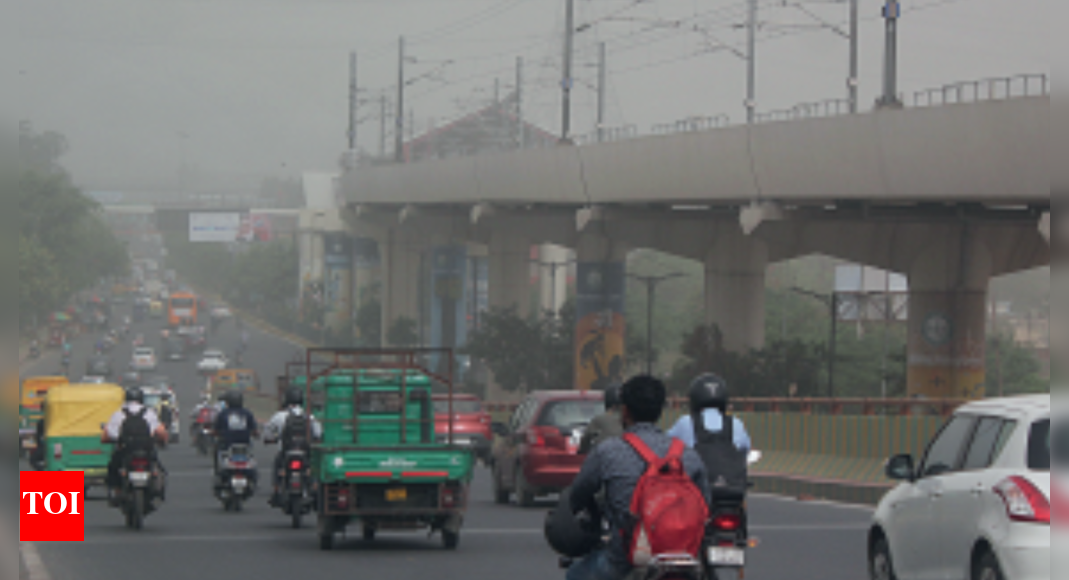
As per the Central Pollution Control Board (CPCB) data, Noida recorded an average air quality index (AQI) of 324 on a scale up to 500, while Greater Noida registered 339 and Ghaziabad 317, all in the ‘very poor’ category. Noida recorded a ‘very poor’ air quality – AQI 302 – last on February 22 and Greater Noida (AQI 316) and Ghaziabad (AQI 327) on February 18.
According to experts, the National Capital Region (NCR) witnesses long-range transport of dust from Rajasthan, neighbouring areas of Pakistan and even Afghanistan during summer months. This year, a combination of intense heat in northwest India, parched soil due to the absence of rainfall and strong winds have made Delhi dusty and left NCR choking.
The Commission for Air Quality Management (CAQM) said its sub-committee has taken stock of the current air quality in Delhi-NCR and found it to be an “exceptional episodic event leading to continual dispersion of dust in the ambient air over entire Delhi-NCR”. It stated that the conditions were likely to improve in 1-2 days with rain expected on Thursday.
The CPCB data, meanwhile, shows that on May 1, Noida recorded an AQI of 100, Greater Noida 96 and Ghaziabad 74 – all in the ‘satisfactory’ category. The air quality, however, has been deteriorating since then.
In Noida, it slipped from ‘satisfactory’ to ‘moderate’ on May 3, and then to ‘poor’ on May 6. There was a slight improvement for a few days slipping to ‘poor’ on May 16 and subsequently ‘very poor’ on Wednesday.
Similarly, Greater Noida’s air quality has seen a steady deterioration and was recorded in the ‘very poor’ category on both Tuesday and Wednesday. Ghaziabad also recorded an AQI of 296, which is in the ‘poor’ category, following an early morning dust storm on May 16.
Meanwhile, the Metro Heart Institute in Noida said there was a rise in the number of patients complaining of respiratory and cardiovascular problems. Dr Deepak Prajapat, pulmonology and sleep medicine at the hospital, has advised people to use air purifiers at home and wear N95 masks.
With inputs from
Abhijeet Singh